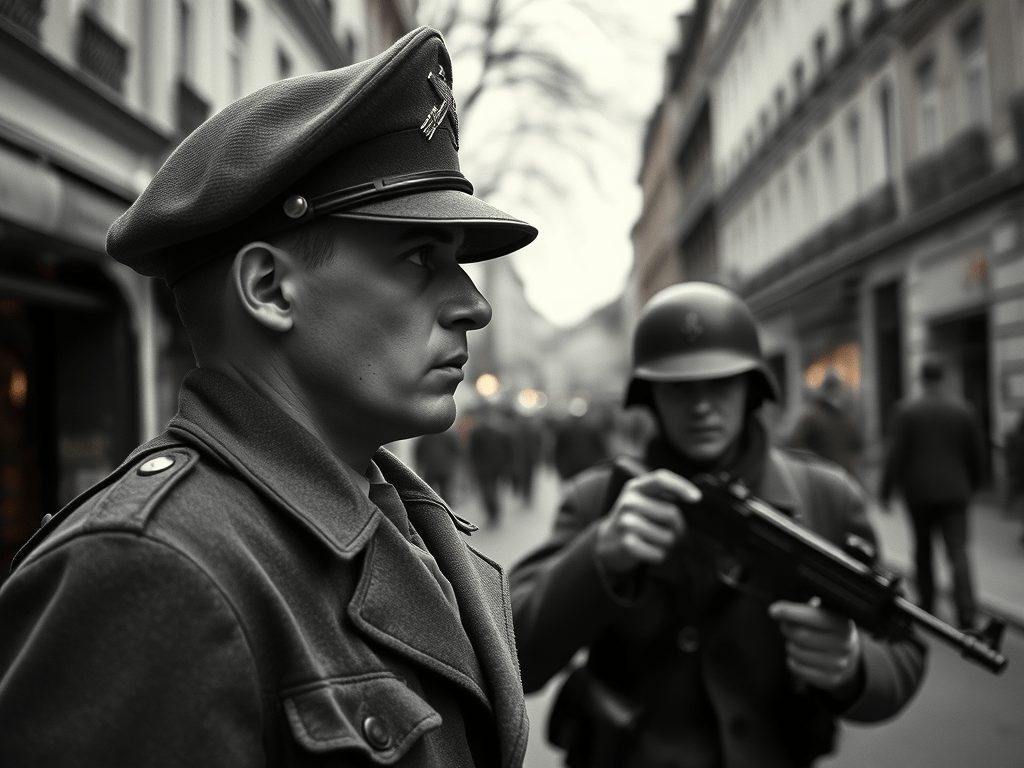
Jus ad bella, jus in bellum – the justice of war and the justice in war. Whether first the action that is going to war is justifiable and secondly whether the actions taken during war are justifiable. Often these are confused, persons believe that if you can justify the act of war you by implication justify the actions that occur within a conflict. Not so, we will examine some difficult scenarios to expand on this point…
Ok so it’s 1942 and you’re in Paris France, your part of the French resistance. You happen upon a German soldier having a bath and you shoot him dead, you had no idea that he was a clerk in the command office and he had never fired a gun in his life, all you saw was a uniform hanging on the peg and you knew he was a German soldier. There are some different ways we can look at this event.
- 1) you had to shoot him because he was part of the problem, his association with the occupying forces makes him as guilty as any other soldier.
- 2) you had to shoot him because he had the potential to harm you or your people.
- 3) you had to shoot him because his loss inhibits the enemy’s ability to function properly.
- 4) you should not have shot him because he was unarmed and not an immediate threat.
- 5) you should not have shot him because he was a non-combatant soldier.
- 6) you should not have shot him because you didn’t know his intentions clearly, he could have been working against your enemy from within.
You see the problem the bathing soldier presents? There is a muddle here, whether or not to shoot the soldier is not any easy decision because you don’t have all the facts. If he was on the battlefield pointing his rifle at you then there would be a clear intention to react to, it’s a fair assumption that it’s you or him, but when he is having a bath it is not so clear. Some would say to shoot him because of potential or association, but soldiers in a war are not always voluntary participants. Some might say he is not an immediate threat so he shouldn’t be killed, but such inaction has no effect on the outcome of war that is positive, i.e reducing enemy numbers or reducing enemy efficiency.
There is another consideration, does this man have a right not to be killed and if so then what action has he carried out to negate that right? If we contend that any person has an inane right to not be killed by another person then we must identify the circumstances where this catagorical moral rule may not apply. He must have done something to enable us to kill him, an action. Is it enough that he put on the uniform? Is it enough that he is German? And what of the supporters of the enemy? Can we blame them and treat them as combatants also? That’s what we are doing when we bomb a city, we are associating the general populous with the actions of it’s government. So if they voted the government in and the government chooses war then they chose war and they no longer have the right not to be killed. That can’t be correct I don’t think? By this logic then we can blame all the way down, without excluding anyone. It is by this logic that the cook or postman can be tried and convicted because they worked in or were associated with the death camp.
Onto the action of conflict, if my enemy is easily identified as my enemy and also I have no doubt that they have negated their right not to be killed, then what does the manner or the mechanism of that outcome matter? Well if you unload the rifle and have the soldier beaten to death with the buttstock instead of shot then you might be guilty of using unnecessary force. There is an expectation in combat that the least violent way to operate is always the best, this protects the actor from accusations of enjoying their role in the drama. For if they had bullets and they chose the buttstock instead then that might reveal something negative about them. So we have a problem here now as well, what force is justifiable and what is the criteria for force? Imagine that you have a prisoner, you can’t prove that he knows anything but you suspect, do you put the thumbscrews on him? Do you read him vogon poetry? I watch movies, as maybe you do, and I’m always aware of both the dehumanisation of the enemy and the heroic perspective applied to the fallen on the side of what we refer to as ‘the good guys’. There’s no sad music when the enemy is strafed by the machine guns but there will be sad people in reality, Neil Faulkner points out that the enemy combattant may not be any different than you are, they may be family men with a lot more in common with the Tommy than the commandant.
Let’s also say that you have the morale option, knowing that mass destruction will destroy support for the enemy with their own nation, would you exercise that option? It may backfire, it’s unlikely that the London blitz did anything other than strengthen resolve on these shores. But let’s say it would work, is it a justifiable act of conflict? It has parallels with the idea of torturing the innocent relatives if your prisoner if torturing him hasn’t worked, is that ever conscionable? The enemy of my enemy may be my friend but is the friend of my enemy my enemy? Morale but maybe not so moral. So we are stuck here trying to identify reasonable actions and appropriate circumstances.
Another way is to simply not participate, pacifism – to decide that no act of aggression is justifiable under any circumstance. This seems only reasonable if all persons are pacifists because it does not achieve anything if they are not. Let’s say then that pacifism is an ideal position, like communism, great in principle but not practically realisable (communism would work fine if, and only if, all would share and none were greedy). Contingent pacifism is a modification, one whereby action is prohibited until it is forced, a reactve approach then. Pacifism and contingent pacifism are both positions where the option of conflict is greatly resisted. This aligns with the idea that the least violent manner in which to conduct the killing of the enemy is preferable. But is killing ever preferable over not doing so?

 pinkfloydpsw's Blog
Leave a comment