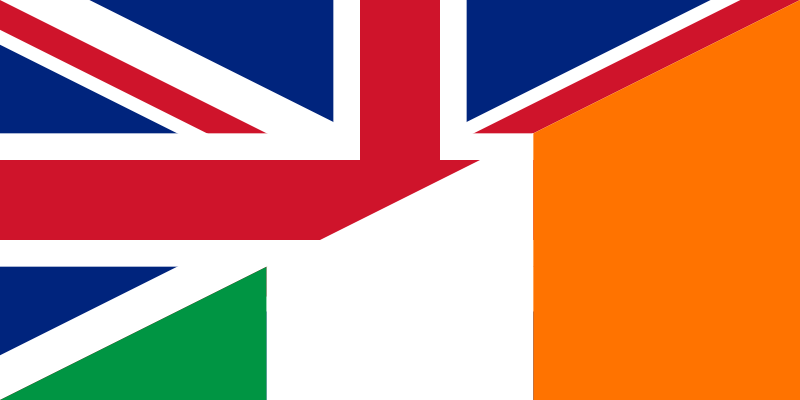
An old friend phoned last night, he reminded me of something I had been thinking about a long time ago when I lived in my home country. I am from a place where prejudice permeates every conversation and every interaction, my country has effectively got two simultaneously active and opposing cultural identities, the Irish and the British. Now I describe myself as a British man but my friend might describe himself as Irish. Is this problematic? No I don’t think so, and why that is so is that I recognise his right to culturally identify with his Irish heritage while he recognises my right to do the same, but from a differing perspective. The point is that we let each other be different yet we remain closely identified with each other because we are from the same place, we chose to see more commonality between us than difference. For a lot of Northern Irish people this is a problem.
Watching the DVD box set of Band of Brothers one might notice the same chord being struck, at one point in one of the interviews that accompanies each episode (the one set in the trees, I think it’s called Bastogne), an American soldier says when describing his enemy “we might have had a lot in common he and I, he may have like to hunt or to fish”. What he recognised, and what we all must recognise, is that although people might be ideologically or culturally opposed, common people have common thread. I have in common with all persons (normal persons at least) the inner desire to be both emancipated and accepted. My right to align myself with a history and the artifacts of that history is culturally important in knowing who I am. Life is not a blank slate – I was born somewhere, some-when, in some culture and to some people who had prominent beliefs of their own that I also learned, and who were affected by their own cultural submersion.
So we can say that the cultural affects that effect us all are not easily discarded, but why would that make them necessarily problematic? Psychologically we make the mistake of thinking that our influences are of our own choosing and that they are superior to the influences of others simply by being our own. In NI people fight and even have died over who has the correct cultural influences weighing upon them, this is a tribal mentality that truly belongs in the past where barbarism more normally lays. Every NI citizen has experienced this conflict at some point, we have all been witness to its unfairness and it’s oppression. Do nationalists have a point about the oppression their ancestors suffered under the rule of the British, yes they do, a strong one. Do Unionists have a right to preserve the status quo and not have to pay reparations for an empire they themselves did not create and were not part of? Yes they do. Do people who don’t care either way have a right not to live in a place of violent struggle and overt bigotry? Yes, of course they do.
What I chose for myself, and my friend, is to be aware of the past but to not let it ruin the present. We can have our culture and yet respect the rights of another to hold theirs as just as important to them. His nationalist (all-Ireland) political position and my unionistic (part of Britain) position are certainly politically incompatible, but that doesn’t mean that we are incompatible as people, in England people more usually vote Tory or Labour, they don’t then after the fact petrol bomb each others houses and burn buses in the street regardless of the stark differences that that country will experience if either one of those parties comes to power. I know the argument would be that NI would be radically different if it were part of a united Ireland, but I don’t think that the reality of that necessitates violent struggle and division. After all what would actually be different? We would spend a different currency and maybe learn a new second language, whoopdy-do, not much to worry about then since we would still be living in a democratic country that holds elections and is ruled by consensus. what I am saying is I would be happy for it not to happen but if it did I wouldn’t oppose the will of the majority. There’s no reason to fight over it..

 pinkfloydpsw's Blog
Leave a comment