
As a man I find inside myself the desire to build things, mostly that urge manifests itself with projects concerning computer systems, but I’ve always regretted not becoming a tradesman in my early years rather than a geek. My grandfather was a joiner and a builder, I should really have learned from him as a teenager, it’s not too late now though to get started I think.
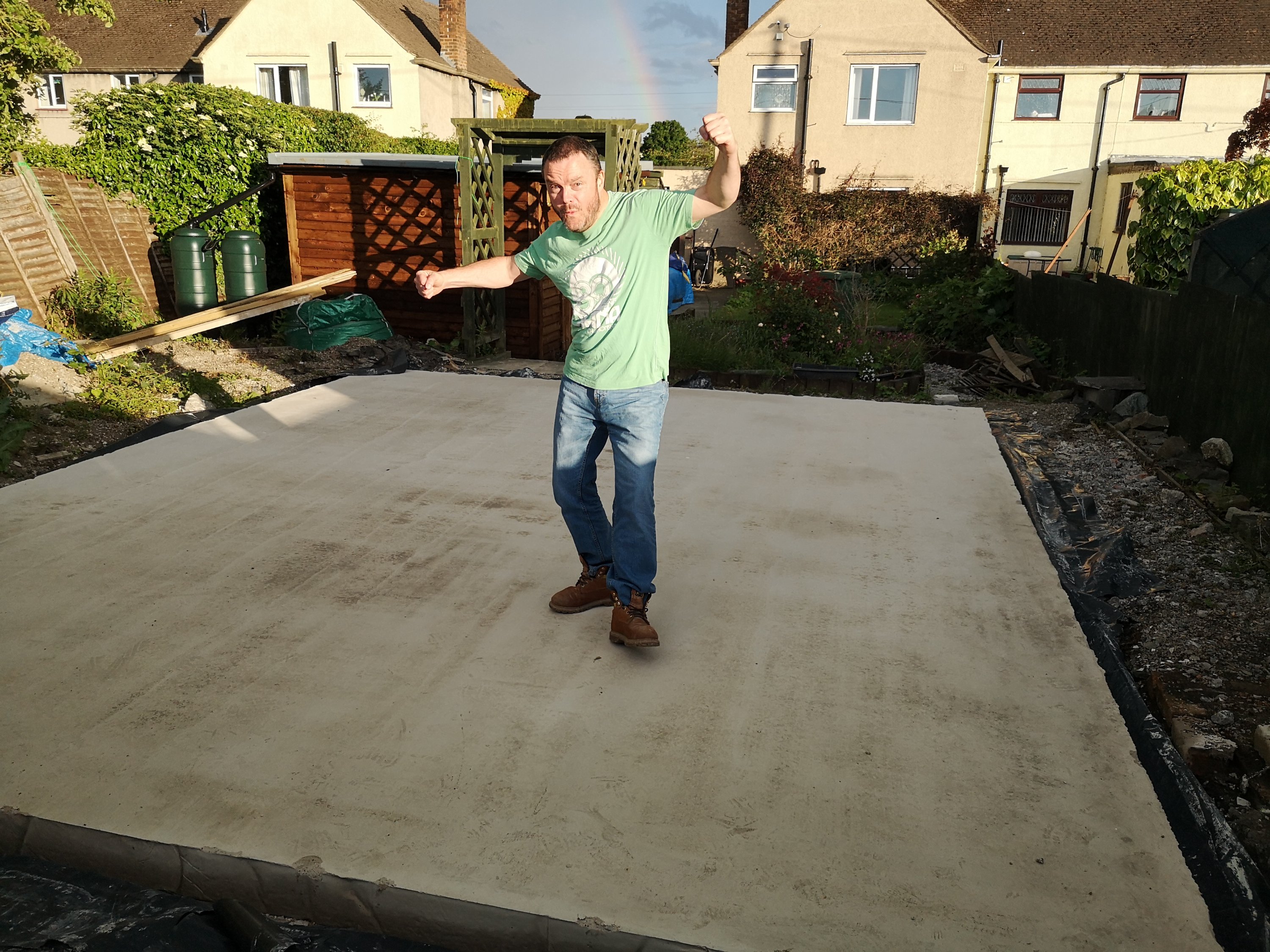
This was the middle point of the major project, that’s my pal Dave standing on the base of his new garage/shed/workshop which we were building at the time, it’s about the only part of the project we didn’t do ourselves.
I recently conversed about the differences in the sexes, a friend had read an article on how in early life guys are preoccupied with things, and gals are more people focused. Now he didn’t mean the accumulation, but the understanding of things, as I had initially misunderstood. I agreed, and I agreed that what occurs in a natural way, the desire towards one direction or the other, was not an indicator of gender inequality, though it’s often mooted that way when it manifests later on with more male engineers and more female carers employed on the roles.
So when we hear of there being unequal ratio in a role, and we hear that there are plans afoot to repair that fact, do we honestly believe that whatever resource is provided to do so will be successful? Choices follow possibilities, the social conditions must be there to enable more female engineers, and in truth I believe they are already. Nobody faces educational barriers any more at any level, gone are the days when your teachers told you what you’re not capable of. Maybe the past has a stain on it, but the present and the future don’t. SO why does the argument still rage? I worked in an educational establishment where there was always government pressure to recruit more females to skilled labour roles, but no desire to recruit males into more service roles, and that I found strange because there was a measurable imbalance for sure but it was to my mind organic not structural. So why is it that there is action to correct this? It is simply because there is an assumption that the why of how it comes around is mooted as, and assumed as, having an interventionary prejudice present within it. Like there is a deliberate block in place of females being able to choose the courses and careers that are available in skilled labour, but if nobody is actually doing this then is the intervention doomed to fail? Not necessarily, it may be that the reason why women do not choose to be plumbers and brick layers is not as I might have once assumed, that they do not want to be, it may be that there are no role models in those roles doing the job and proving that they can compete in the workplace as skilled individuals. Looking at it this way it may be a good thing to exemplify those women that do choose, to put them on the cover of the prospectus in a hard hat, to award them with certificates for their efforts. But that itself becomes a prejudice does it not?
Let’s say like me you were skilled labour and an achiever, I was a very well thought of systems Tech in a previous role in the British forces, in a team of capable technicians in London. My stock was high and my career was assured, and at one point I was described as one of the best Technicians in the division and by my Officer Commanding as the best Tech he had. At the same time I lost out in promotional terms and in prominence to a female technician that was, in my estimation, somewhat inadequate at her job and who had needed much help on a daily basis in technical matters, yet she had been promoted and given travel opportunities ahead of myself. I also had a female superior that, although she was also a technician, never showed any ability to be one (again in my estimation only) and seemed to occupy the role of admin in the technical wing of the unit. At the time I thought this unmerited, I was, by my own considerations and those of others that mattered, a superior soldier and a superior trades-person than this other individual (my contemporary, not the higher ranked aforementioned person). That doesn’t mean that given the right support I would not have been eventually out-shined by this person, and I’m not saying she was not capable of many things in many ways, or lesser as a person than I, nor dumb in any way, in fact I’d hate to come across in this piece as some sort of misogynist, this is not a male rant.
Was I missing the point at the time? That’s very likely. What I hadn’t realised was that it was important to the forces that it did not change organically because that would take too long, it was more important than me for this institution to grow and repair it’s past without fulfilling what I though I deserved. Did I miss out? Yes, was I being treated equally? No, is this way of doing things okay? I guess it has to be… Inequality is only a problem when it affects you negatively I suppose.

 pinkfloydpsw's Blog
Leave a comment