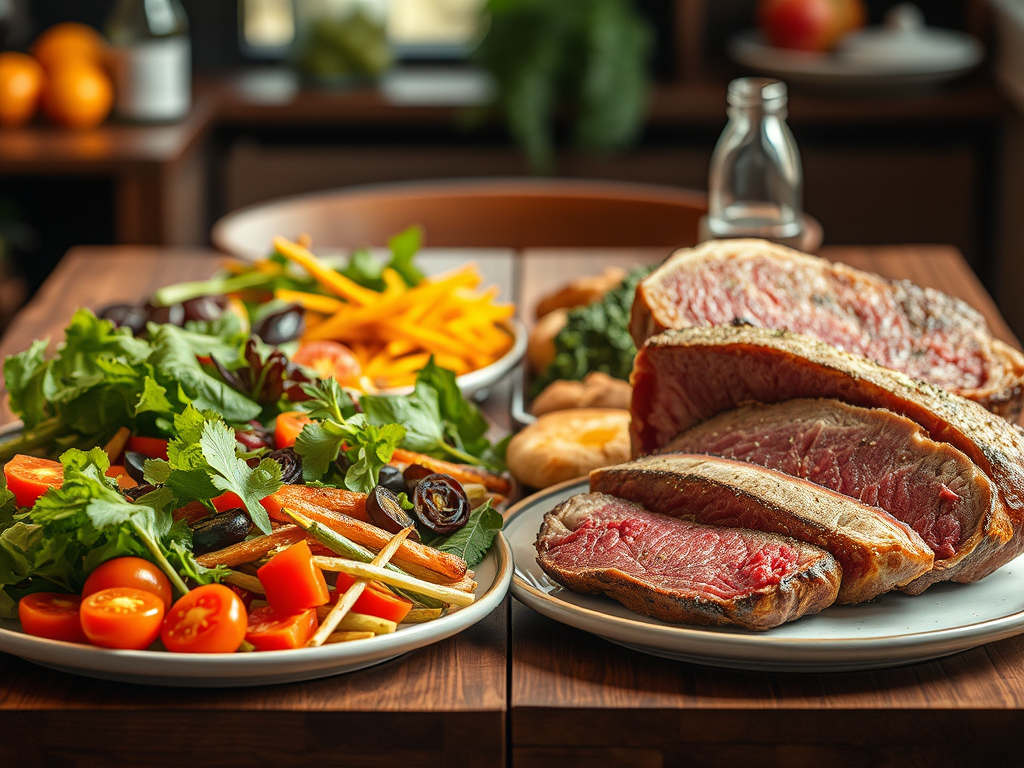
I used to be a vegetarian, a choice I made in my youth. Let’s first dispel the myth that that lifestyle is bad for you, I was a professional full time soldier when I did not eat meat at all, I was not slow or weak, nor was I deficient of muscle mass, and I was very very rarely ill. Vegetarianism is not for everyone, because it’s not everyone that can consume dairy or meat products and live well, some are allergic and for others it just does not make them feel good.
Veganism is where you do not eat animals, or use products that are derived from animals at all. No leather jacket, no gelatine in your food, no fats from animals, no products tested on animals. A rational position for those that wish that the animals lived free from our tyranny and control, they, as a vegan, wish to be better people by their choices, and who could decry them for that noble position.
The health benefits of a vegan diet may be arguable, but the farming practices that support veganism are enough reason to say it is a good thing. In a comparison between conventional animal farming and plant farming it is the latter that uses less resource, and by a long way. Diet wise there is a lot that missed by not eating dairy and animals, the diet of the vegan has to be planned meticulously, and the most important thing seems to be to strongly avoid any foods that claim to be made specifically for vegans as alternatives to what we might call conventional meat products. Since most people’s idea of going vegan is to purchase supermarket goods that have the label VEGAN on them, then most people that go vegan are eating low nutrition, high sugar, highly processed, garbage.
I personally eat meat, but I am a flexitarian, I don’t eat all meats, and I only eat meat that is an actual piece of an animal and not processed or riddled with additives. My chicken is organic breast from corn fed non battery, my bacon is nitrate free, and I would rather eat the cardboard package it comes in than the sausage roll inside. I don’t accept the idea that humans have to eat meat, but I also don’t accept the idea that humans shouldn’t, and into the bargain I don’t accept the idea that people aren’t meat. That one is controversial, but it’s hard to argue against. Sure there are moral arguments against eating people, but very few practical ones as we happen to made of the same stuff as other animals, meat.
Why I called this piece a paradox was not because there is a paradox inherent in being a vegan, or a vegetarian, or a meat eater, it was because there is a difficulty in getting any sort of health benefit message across to an audience that you may alienate by the action of trying to help them. Where the vegan proselytises and evangelises the beneficial nature of the movement, he or she may cause people to feel like they are being blamed and are responsible for the many ills of the meat industry, by being a consumer and by implication their customer. Yes, in truth they are, but it is not a consciously made choice to be a participant in harm if that person is in happy ignorance, and here is where the problem lays. People, as Morpheus puts it in the Matrix, “are not ready to be unplugged”.
After 200,000 years of eating animals, unproblematically for most of that time until the food industry became what it is, it was never going to be easy to convince the meat eater that they are causing harm to the planet. Yes in the 1990s we noticed the hole in the Ozone layer, and the public concern caused government action on the banning of CFCs, and so the ozone has repaired an we can call this a great success, but it is an example of an acute circumstance rather than a chronic issue that slowly worsens. The approach taken by campaigners was aggressive and it worked, they had children on TV bemoaning their government. Using the same approach toward other environmental harms has not proved as effective since people only seem to care about things when they may be affected by them, and they do not yet feel affected by climate change or other harms caused by the food industry.
The actions taken by governments we could say are soft because they are allowed to be by people, who seem easily sated in their need for action by actions that appear to be an intervention yet may prove to be themselves errors of judgement. I refer to the addition of chemicals in animal feed to stop cows from farting. I’m not a scientist but this one seems wrong. Are they farting so much because they are eating broken biscuits instead of grass, would they fart so much if they just ate grass like they are supposed to? The additive is being put in feed, but why do cows need feed when they have an abundance of their natural food stuff? I suspect they get “feed” because it makes them heavier quicker, and for no other reason.
There are few ways to make people change behaviour without force, one is to educate and persuade through that education, the other is to scare, again with knowledge. If we promote the benefits of veganism then we will get nowhere because people will chose to think that they need meat, or will chose that they prefer the taste of meat. If we scare people then we have to be accusatory, and that will also get no results because people rally against aggression in argument, and often do not accept criticism. A person will say that their small token makes very little difference, and they may be correct. So what can be done?
Years ago, meat was a treat, a luxury reserved for special occasions and those that could afford it. I say we let it get back to this condition. The reason is that livestock is hard to maintain and meat should be an expensive item to purchase, and in fact is if it is grass fed livestock from pasture, allowed to grow and develop naturally, and not saturated in chemical intervention. Organic meat, the type we (Em really) buy, is very expensive, prohibitively expensive, to the point where we treat it with reverence almost. This would not happen with a potato. If we allow meat to become that quality product it once was we could achieve two things, lessen the consumption of it, and lessen the impact of it environmentally.
It is the meat industry that is at fault, and the government to blame for letting them produce a product that does harm and is less in quality than it should be. Only by the actions of the government could we return the practices of farms to something sustainable and still profitable for them to do, and that means to allow natural price rises that reflect quality and not quantity. Quantity is the mitigation of the problem of quality production, it is only by corner cutting and intensive practices that the price can stagnate as it has done, and be in relative terms cheaper in 2025 than it was in 1925 to eat a steak. I’ll bet the steak of 1925 was a lot better a food item than the one of now.

 pinkfloydpsw's Blog
Leave a comment