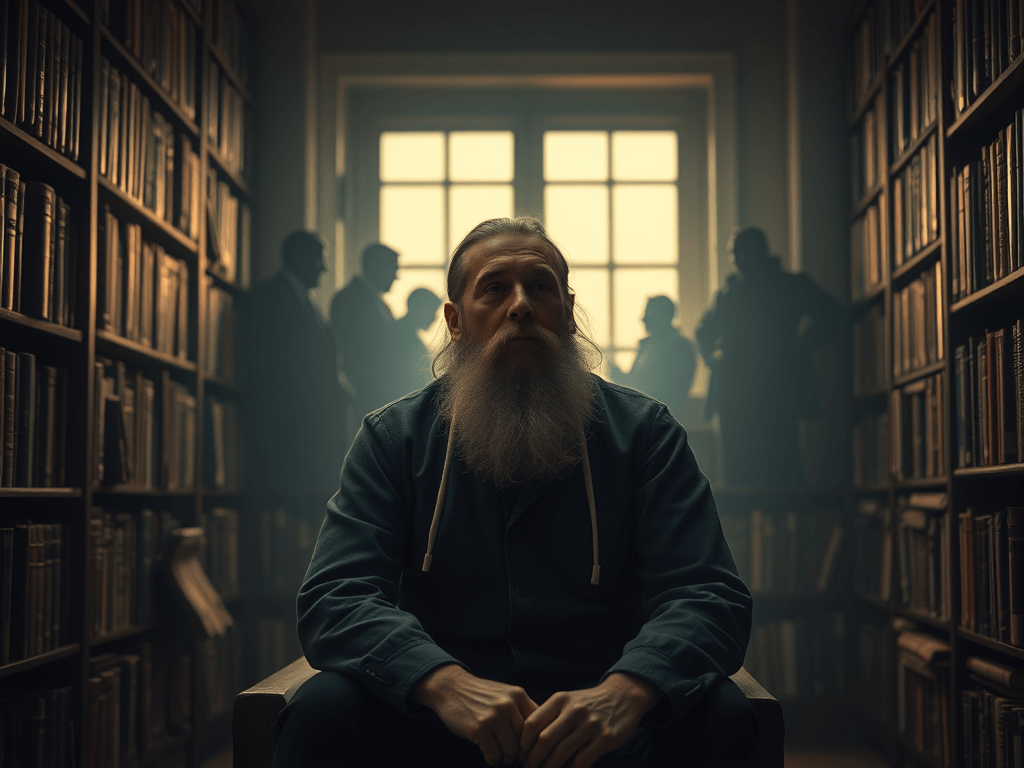
I’m a big fan of reality, telling the truth, representing yourself as the flawed human you are rather than the modern overprotected ego creation I described in earlier posts. For this reason I am often drawn to the philosophy written by critical thinkers. The masters of suspicion as Roderick references some of them in one of his series of teaching videos. He talks of Marx, Nietzsche, and Freud, but I would add Schopenhauer, Camus, and Darwin to that list from history, and in modernity I’d include figures such as Michael Parenti, Noam Chomsky, and James Baldwin. These are not merely writers that whinge, they are constructive critics, with purpose.
Man can live under oppression if he understands why it exists and what human psychology drives it. It is not that we wish constraint and the effects of powerful actors to be upon us, it is that within these conditions we can still find ways to express and realise our goals. It is too easy a prospect to be miserable, and to blame that misery on conditions that we cannot change, then give up and stagnate or live miserably, ever peddling a lack of opportunity, resource, or power, as an excuse for inaction. We could wave a flag or protest, never making a difference to the structures that oppress, at best merely contributing to a change of oppressor or regime. One that would differ only slightly from what it was replacing. This is the illusion of progress, and it is a very useful illusion for the powerful to use. Of course there is a temporary satisfaction to be gained from illusion, but that does not mean it is not still a falsehood. One strategy is to just accept that things cannot be changed, that there will always be a tyranny of power, and act accordingly, doing what you can do, living the best way under the circumstances.
Britain replaced the Tories in 2025 by electing the Labour Party, but what changed? Absolutely nothing, because the same social conditions, the same structures of power, and the same type of people who gain power, replaced their very similar predecessors, yet are no different from them in any demonstrable ways because they are motivated by the same selfish goals and funded by the same motivated power people. We should have expected this, but we let the illusion fool us once again. George Santayana said “those who do not remember the past are condemned to repeat it”, we all know this quote in one way or another, yet we still repeat the hopes of the past. That’s interesting, maybe we are simply stupid, or maybe Arthur Schopenhauer was right, that we are a creature of will that organically follows a perceived strength because we prefer the illusion of correctness over the uncertain struggles involved in finding anything out. Personally I like to see past the illusion, I’d ask who favours false satisfaction over harsh truth anyways? Most folks it would seem.
Schopenhauer wants us to stop being participants in other peoples need to be pleased, he says look for peace within yourself, and stop comparing yourself with others. Accept that life is unfair and suffering is inevitable, in fact the smarter you are the more you will realise, and so the more turmoil you will be in mentally. As far a physical pain, that engenders compassion for the self, and therefore compassion and understanding for others. For Schopenhauer this compassion could not be attributed to the natural morality of men, because men have no natural morality. We all just naturally follow our will. Morality is the creation of people with compassion, so to suffer is to understand that others may suffer, and to be compassionate is to allow others more scope for their rights than they would have in the natural balance. This seems harsh, but history is not replete with compassion, it’s more full of harsh competition, even in the circumstance of abundance life is brutal and unsympathetic. For Schopenhauer this was evidence that people would always be driven by their will to want more, but progress would never satisfy. Lacan, the French philosopher would echo this years later in his statement “desire is always for the other”, meaning it cannot be satisfied.
In recent times we can see where Schopenhauer’s postulate is proven true. For the people of Britain to slip so easily into the comfortable illusion that such folks as have been elected are actual men/women of the people, is a stark example of what he suggests as the preference of confidence and certainty over doubt and honesty. We know that the world of politics is a complicated business, we further know that one person cannot understand all of what is occurring and what is planned and what is likely, yet we absorb the confident output, the bullshit, of charismatic candidates for high office like we have turned off our rational minds temporarily so as to make them, those charlatans, able in our estimations by sheer will alone. This is as sensible as the Ostrich tactic of thinking that if it cannot see you then you cannot see it, what you decide to ignore then cannot stand in the way of what you wish to be so. It is the inevitable dissatisfaction that comes from being forced to live the results of our decisions, which cannot be denied other than to engage in a dissonance, that Schopenhauer believes contributes to an ongoing turmoil for our happiness. We know we should know better, and we know we made a mistake, but we continue to deny that we are culpable. Reality, realism, is better because it is acceptance, and acceptance relieves turmoil more satisfactorily than false hope and recurring disappointment can.
Schopenhauer looked to the east, to doctrines of acceptance, to build his philosophical view. It is no wonder it feels miserable to us because it seems to have no mobility in it, we might describe it as akin to stoicism. We know that Eastern philosophy encourages acceptance, yet prescribes excellence in action; to aim to be the very best horse tail groomer you can be, but to never wish to become a horse mane groomer as a result. This does not suit our western minds, we are ever working toward a better future with more accumulated objects and increasing power. Over and over though we see the most happiest of persons are the least intelligent, the least prideful, and the least desiring of us. For Schopenhauer this would be a vindication of his theory, that elimination of will is satisfaction, and happiness is found in the little things that have no down side or no cost to them. Unfortunately for him he was extremely curious so he became extremely well read, developed extremely high intelligence, but his will was then to point out where everyone else had got it wrong.
So Schopenhauer’s personal dissatisfaction arose from not being listened to while he espoused how you should not look externally for satisfaction. This is somewhat of a paradox, since Schopenhauer wished for success in his writing, and his writing was about how desire and success were the playgrounds of unhappiness and falsehood. Schopenhauer had witnessed and noted where success came because of power structures, themselves built on illusions of confidence and perceived strength of will, but his philosophy is a doctrine of criticism rather than a manifesto for living, so he was simply a bad fit for the, possibly illusionary, positive nature of his time (industrial and technological progress). It’s possible his bitterness produced his perspective and drove his philosophy. Like all great writers he is trying to give insights that will help, but unlike positivist perspectives that claim human history is progress, his work, just like the works of his suspicious contemporaries who I mentioned earlier, points out that fundamental human problems had not been in any way solved by having better things in his century than the ones that preceded it. We could state the same now, in fact Rick Roderick also points this out in his lecture series speaking in 1998, that after more than 2500 years of western philosophical thought we are no closer to solving the basic conundrum of how a society ought to be structured so that human dignity and moral rights are provided for all persons, than when we started thinking about it.
Schopenhauer also poses a real problem for science and progress, yet also makes those disciplines better by having to work harder if he is correct, in that he thinks that there is no objective reality, that each person sees the world through a lens of their own biases. Why this is problematic is where, if he is correct, I cannot be certain that we are agreeing on the same thing because we are not evaluating the same thing by our differing senses. Our perspectives cannot be the same because of both our experiential bias and our sense experiences. From each of our points of view, our own objective reality, we are seeing differing objects (I don’t just mean objects as real things, include theories and concepts in that also). Where it makes science better is where it forces out all subjectivity by identifying it as a primary problem. Historically, pre-enlightenment and empiricism, the canons that underpinned all of life were human judgements delivered by powerful individuals. For politics this has a much greater implication, since it is subjective by nature. A politician may tell you that they are going to pursue a strategy and X is going to be the result, and they may try to make you think that they have looked at stats and done research, but it is still a guess in that the reactions of people are often not in line with what has been modelled. The political figure is often then forced to try to make what is a failure, the result, look like a success, we call this “spin”.
We have seen our politicians get it very wrong before now. Think Thatcher on Poll tax, Cameron on referendum, Truss on economic direction, and Johnson on just about everything he touched, mistakes were made and they were a surprise to those that theorized, or had a think tank do it for them. Schopenhauer is correct, you look at the world the way you look at it for the reasons he states, it is hard to take a perspective that is not your own. For us to work together toward some sort of harmony in society we must achieve this impossible task though. You as an actor would have to work out how you would think if different things were important to you.
What I get from Schopenhauer is the feeling that a false comparison makes a person unhappy. I wrote a post a while ago about the two monkey problem of perceived inequality causing unhappiness and I stick by it, it does cause unhappiness to think that you are being treated differently to your contemporaries. What should not cause unhappiness is the fluctuating conditions of necessity in the face of changing resources, say like the world running out of energy, or the harvest being decimated by weather, that is unless the burdens born by these problems are on the shoulders of those least able to carry them. Schopenhauer does not give us a strategy for this, whereas Marx does (revolution), and that might be a weakness in his philosophy, that the coping mechanisms he espouses are not active and progressive, they are passive and accepting. For this reason I am not entirely bought in. I like a bit or revolution from my critics, a bit more anarchy.
When it comes to love, Schopenhauer believes that we make bad decisions. His philosophy points out that the rational mind is often in conflict with the will, and in matters of love the will wins. We do not choose who we love, if we did we would choose with better strategy. He thought the will to life would drive us to find balanced attraction so as to produce balanced offspring. I think Schopenhauer sort of felt sorry for people since they are driven by urges and goals that they cannot become aware of in rational terms because they have already rationalized them within a mistaken acceptance as being part of a plan they think makes sense. Freud reveals some of this in his work when he uncovers a sort of hidden instinct within humans that we have little awareness of. The problem is that when we do become aware it doesn’t make life easier, quite the opposite. For Schopenhauer our intellect leads us to unhappiness. The mole or the rabbit these existential issues do not arise because they lack the intelligence to think deeply about them, and some humans fit this model also, the lucky fuckers.
In Schopenhauer’s work I see Marx politically, Freud psychologically, Lacan and Camus sociologically, Marcuse on product, and Machiavelli on rule, he may be one of the most underrated philosophers of recent centuries. Reality, the reality of humans, is miserable, what we want is closed off to us in awareness, and if we become aware we become unsatisfied, feeling more imprisoned. We will always be ruled by tyrants because only people with a will to be powerful will convince us that they can be, and we will suppress our rational minds so as to let them. We are dissatisfied by nature, and no progress brings more than a temporary happiness. It is sort of miserable, but it gives some hope for freedom to be realizable outside of the product and the social structure, the strategy must be ambivalence.

 pinkfloydpsw's Blog
Leave a comment