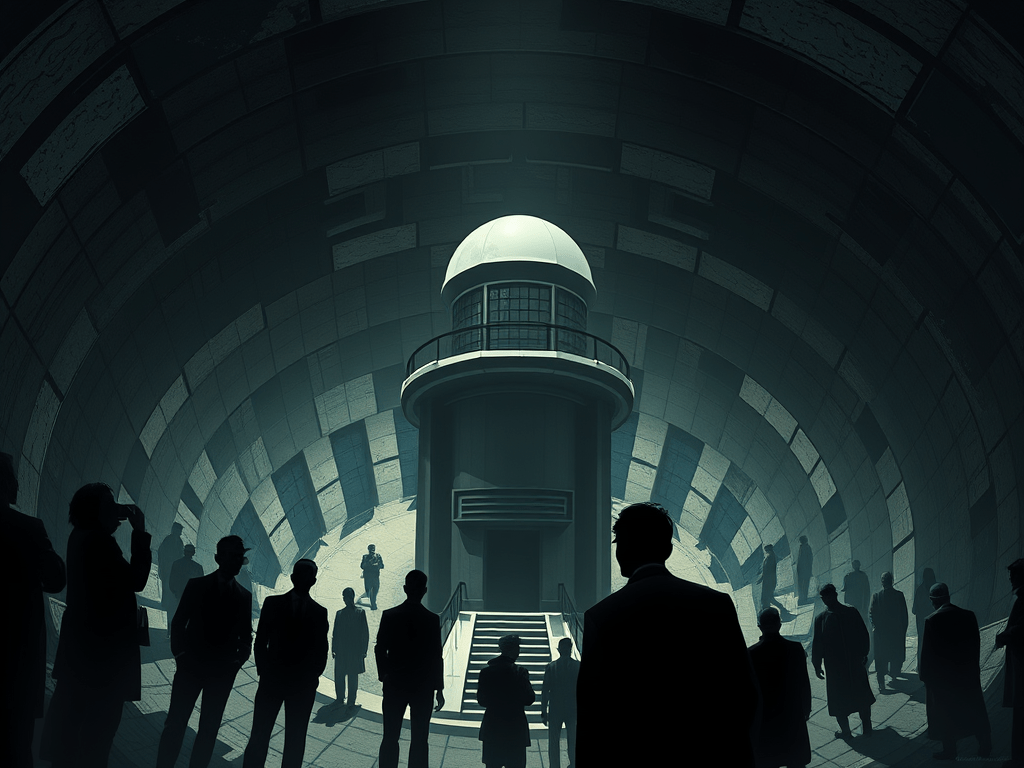
The panopticon was a theorised building that Jeremy Bentham came up with, its purpose was to watch without being watched. He imagined a structure designed so that any person within it could be observed at all times, that all persons would realise that this was so and therefore assume that they were always being watched, even if it was not so. This assumption held because they were not able to see who was watching them. This thought experiment removes the idea of personal privacy. In this piece I intend to take this further than its implications in Bentham’s time because his was a narrow postulate concerning just prisoners, and in those circumstances his invention might be a perfectly acceptable measure. Bentham lived long before CCTV and audio recording devices, he did not imagine that one day it would be technologically possible that machines would watch all people.
At this point it may be relevant to ask you to bear in mind that Edward Snowden already warned us in 2013 of the mass surveillance state and the power we did not know it had granted itself based on its possibly skewed logic concerning what was in our best interest. What he revealed should have scared us all, but literally nothing has happened, as far as resistance, then, or since, about it. This signifies that even if people know they are being watched, they do not also assume that they are being manipulated by that watcher.
Foucault wrote, of Bentham’s plan, that it would form the fundamental building blocks of control, in that the assumption of continuous observation would change the way people would behave. This is, in one sense, the observers paradox, where the observation changes the result of what is being observed, but in this case it is the goal to change the behaviour of the observed individuals. When we know we are being observed, and we know that that observation will be coupled to certain judgements, because of course the goal of observing people is to decide something based on the information that is their habits and behaviour, then we act differently than if we were not being observed.
This is not a supposition, it can, and has, been proven. So observation is actually a usable method of shaping behaviour, it is not simply an exercise in knowing how people behave. My pal Dave likes to say that “you cannot make a pig heavier by weighing it” he is referring to the constant measuring of performance regarding colleges, but that’s a pig. If you keep weighing a human they will act like they are going to be weighed and this will change their behaviour before getting weight. When you measure human behaviour you change it. If anything, it is the knowing of how people behave when they are aware they are being observed and assume they are being judged. This is not useful at all to science, but very useful to governments and institutions, it is also useful to employers, because they can shape the actions of their employees through signage, assumption, and overt surveillance device placement. Glenn Greenwald refers to this as “mass surveillance creating a prison of the mind”, saying that this sort of coercive force is much more effective than previous methods (2015 TED talk). I have observed the phenomenon of measuring employees many times, it is always sold to the employee body as a measure to improve performance, in truth though it often works against the goal it purports to be seeking, it changes people’s behaviour so that they work for the measure alone, removing qualitative outcomes and replacing them with quantitative ones.
When a person thinks of privacy they tend to mean to keep private what they assume could be used to harm them in some circumstance. We may want to keep ourselves from being exploited or blackmailed, we may mean to keep others out of our financial affairs, we may not wish for others to know some of our sexual preferences. We think of privacy in terms of personal safety. This need for safety is however exploitable, governments and institutions will use the concept of safety to ensure that they then can control the world of information, thus gaining the power that that supposed protection affords. Think of proposed ideas on online safety, and then consider what the purpose of that measure would be, the massive resources that would be needed, and the effects it would likely have on actual safety. Does it not seem somewhat tyrannical, and thoroughly against the idea of freedom of expression, to allow there to be a power that regulates, in a parental manner, what can be seen in the library that is the internet? And for what benefit and to whom? We could just leave parenting to the parents since there already exists the mechanisms and applications to do this (Net Nanny for example), or we could teach online safety in schools. The reason I personally suspect we do not is that no government wishes to create a generation of people that realise they may be victims of manipulation. Mark Twain regarded government censorship as “telling a man he cannot have a steak because a baby could not chew it”.
Who would you nominate, you as an adult citizen in a free nation, that could decide for you what ideas and media is suitable for your consumption, and what will be harmful to you? This internet safety proposal must have practical methods of intervention that interrupt existing safety measures so as to add the layer of protection it proposes. I’ll not get too technical here but… Imagine that you already use safe measures such as an Anti-Virus, a Web Filter, and a Virtual Private Network connection, and your child’s school has a web filter, and you have installed Net Nanny on their devices… These mechanisms of online safety and privacy must then be compromised using methods of intervention that are supported by government. Or in other cases the content would have to be geo-blocked, which would need the help of the VPN providers to do. I use a well known VPN provider from outside the UK, will they acquiesce?
On a slight tangent, one of the reasons why employers are so often against their employees working from home is not, as it is often mooted, because they believe that those employees will do less work. This is demonstrably not true since output is measurable and measured by something, even if it is just human judgement, under normal business circumstances. No, it is because the lack of dominion over the normative behaviour of those employees is realised when they, the employers, cannot exercise what is a form of power. Employers get used to enjoying the shaping of the behaviour of employees, they do not merely provide employment and tasks, they make policies on conduct, attire, communications, privacy in both an information sense and concerning physical security of areas. When a person works from home they can be in their PJs, they do not have to interact with other employees because of sharing the same space. This lack of control over the person, in any other sense than their tasks, can present a loss of power to the employer that maybe has come to value it. We must remember that employers have lofty egos as a norm, and we can probably rightly contend that they seek power, it is not the burden of kings. Of course I have not mentioned a secondary factor that also shapes the WFH policy, one that may present a good argument against the point I have just made, it is that employers may favour certain employees, so WFH becomes a granted bonus feature of some employees working lives because it is used as a reward of sorts, or to signal difference in value between employees so that they are aware of it. Privacy in this sense, the grant of it, is significant because it indicates trust and mistrust. Power is key here, it is also key when it comes to thinking about why data is so desired.
The online world is filled with potential traps for the weak minded to fall into, it is a dangerous place to navigate because it contains the expression, in technology, of the same nefarious purposes that some people hold in reality. There are people who are out to do you harm, some wish to take from you, some to control your actions for perverse pleasure, some to find kindred spirits that quiet their conscience, and others that wish you to participate in their ego driven fantasy to live a different life than the one nature has provided for them. We are all creating a digital ego self when we appear as any type of online person, it does not matter if this is as a customer, as a social media representation of us, or as a critic. I am doing this with my blog, you do not know me apart from in what I say here that lets you paint a picture of who I am, but that is not likely who I am really is it? What I volunteer is the same as what you volunteer, just what I feel I have to, and just what I wish you to know. Most websites that you interact with appear to be doing the same, and so do applications, social media sites, and search engines, but in reality they are not really staying within these parameters.
If you have nothing to hide you have nothing to fear – the assumption then is that only people who have something to hide will have something to fear, meaning that anyone who feels like having privacy must by definition be up to something that they wish to hide from someone. The implication of this is that they are the ones to watch most closely, so paradoxically anyone that attempts to harden their privacy will become the subject of attention at the very least. The house with bars on the windows and CCTV cameras is the one to burgle!
You may be sitting in your house watching TV, an appliance that you believe serves your needs, but in reality your viewing choices are being recorded in some fashion. Your choices contribute to data sets, they add to other data that is gathered from the devices and technological objects that are in your life. You may have smart devices linked to your google account, you may use google to search for things you desire, you may have a smart speaker that has your playlist on it or analyses your previous song choices to build one for you. You have a satnav, a smartphone in your pocket that knows where you are going and can tell you the best, least congested, route. You might encounter cameras while going to your car, cameras while on your journey, cameras when parking, cameras when entering buildings, cameras while you are in buildings, facial recognition, number plate recognition, and the whole time you will be carrying your mobile phone and it will be push notifying you while building a tracking map of everywhere you have been and everywhere you have paused.
That one is interesting, when we pause we are doing something, checking our phone, making a purchase, waiting for something or someone, reading a sign, using a device, or we have arrived where we are about to work etc. This is where data interacts with other data, say we were just talking about your google smart phone, and we know it has stopped moving, what might we also know by other means, and how can that data be useful (because this is the goal) to both or more parties that are doing the measuring? I might buy a coffee then sit down with a friend I was meeting. Google knows I have stopped, Google knows the friend has stopped, Mastercard knows I have bought a coffee, EE knows I have connected to the open wi-fi in the mall, Santander knows I have £1521 in my bank and I get paid in three days, Amazon knows that I bought a funny T-shirt last month and the month before, Spotify knows that I listen to a lot of indie music…. There is a lot the tech companies know about me, so there is a lot they can then guess about what I might do next…
Your partner may be oblivious to your cheating ways, but you can bet your last dollar that every tech company and financial institution knows what you are up to…
Now, knowing this all, and bearing in mind that that is not the full extent, just what I got off the top of my head, also consider that they are very likely collaborating with each other using my data, would they let any chance to manipulate me just pass them by? I think they would not, I think that the directions I ask for might take me past some opportunity for a sale, I think that my social media might start advertising things to me that I would be likely to purchase on a whim, I think my news feed might start to steer me toward information that is designed by its nature to make me lean one direction or another. I believe that the greatest purpose of technology now is to influence the individual and to create the hive mind. What appears to be a freedom of choice is in reality coercive mechanisms to inhibit freely made choices. The reward we get for our participation is entertainment and better directions.
Rick Roderick postulated that any society that appears too cohesive, i.e. too uniformly in support of a thing, would be suspected of being manipulated. So he proposes that certain acts of rebellion would be part of the plan that ensured people would not realise they were not freely choosing. An appearance of the essence of freedom would prevent real freedom and ensure continuing tyranny.
What is data? It is information, and what is information for? Decisions, plain and simple. You would not need information if you were not making a judgement and then following that judgement with a decision. This could be a choice between two paths, a purchase, the choice of what to read next, or what to pursue with your time. For choices, decisions, we require information, arguably the more information we have the less likely we are then to make an error in our choice. We do not want to end up like Buridans’ Donkey, standing in a field starving to death because the bails of hay are equal distances from us and we have no criteria to decide how to favour one bail over the other (the donkey cannot make the decision because it does not know enough to make one choice preferable to the other is the point).
A doctor needs to know your medical history, this is so they can make a decision on your healthcare, a judge needs to know your history before they can decide if you are likely to offend again, a tailor needs to know your height and arm length, but the parking app for the meter at the National Trust exhibition in Stoke does not need your email address, telephone number and place of permanent residence I would argue. The high street store where you bought 3 sponges and a bucket for £2 does not need your email so they can send you a receipt, that’s not why they want it. The hotel where you are staying needs no more than your credit card details to book the room, they do not need the rest of the info they ask you to volunteer.
Remember that you do not know what the CEO of google or Bing are up to, they take very great steps to keep their lives and data private…
We must live now realising that everything we post online, utter in conversation, absorb through media, travel toward, or chose to purchase, is a contributing object of data in the built digital narrative of our existence, and serves the purpose that the owners and controllers of the financial and social worlds can then make decisions concerning us as individuals, and others as a mass, on what choices are within their power to make available that will be most likely to manipulate our adherence to their needs, our acquiescence to their power, and our agreement with their position. How they will do this is to infer, using what they know about us, our desires prior to us realising them. This will allow the development of strategies to steer our purchases and voting habits. Sounds a bit nefarious that doesn’t it? This is already a reality, the data, as we have just said, must have a purpose. To those that gather it the purpose is to sell it to those that can use it, and we need to start asking what they need to use it for and if it is for our benefit?
It is that serious, those that use big data have become a new type of tyrannical force as a result of it, holding much greater power now than the people we elected. This is why we are, in the 2020s, very clearly watching the people we did elect, being made poodles to the owners of the mechanisms of data, and why we are seeing the owners of those mechanisms becoming more wealthy than we could ever imagine a small group of people being in such a short time. Big Data allows for the generation of big wealth at an ever accelerating pace, and big wealth creates economic might that manipulates political power. Though it has ever been so, it has also always, up until the invention of big data, been in contradiction and conflict with social force (what people want), but this battle may be over since social force is now the real victim of the manipulations that big data creates. All tyrannies with to control people, in history it had to be done with force or belief, now it is done with data.
Like I say, social force may now only be the semblance of the force it once was, with people caring about now only what they are being made to care about. I’ll give you an example… The world watches as the US president frees the rioters that stormed the white house in 2020, he has decided that their civil disobedience was an act that is acceptable, at the same time the US, under his directives, is detaining people for protesting the Israeli actions against Palestine. The way that media acts to justify these incompatible acts with positive or negative values does not simply inform the populous, it drives it. American news is not the stuff of fact, it is the stuff of opinion, their edgy satire is much better as a news source. The storming of a government building by disgruntled and armed citizens was an act of domestic terrorism that inflicted harm on public servants, whereas a peaceful student protest is an act of expressed compassion that threatens no person.
For me, it appears no coincidence that the US President (2025) seems to be singing from the song sheet of his close unelected ally rather than following the lame promises he may have made in campaign speeches. The Prez seems to need the social media mogul to make and keep him president, in the same and opposite way Jeremy Corbyn maybe would have been PM of the UK in 2017 if not for the influence of interested parties that could not only create and manipulate public feeling toward him, but bury truths in a sea of repeated factoids and speculations (a factoid is a something that pretends to be information but is not actually true. A speculation is a postulate presented as a question rather than a statement) by using what they know of the electorate, as a result of the analytics performed on big data, to make them vote against what may have been their likely better interest.
Privacy is by its nature secrecy, and as secrecy is incompatible with the idea of societal security in an individual sense, because the rationale that underpins societal security is that no one person’s personal privacy needs can be allowed to remain in place so as to prevent the expression of law when in concern of national interests. Since national interests tend to be expressed as the will of governments, and governments tend to be made up of people who need the national press to support them in manipulating people to vote for them, and that press is usually owned by media outlets that are themselves owned by vastly wealthy persons who also have interests in the way governments spend the people’s money, we see a battle on the part of the individual which appears to be hard to win. Privacy understood in this way is rendered incompatible with the needs of big data, which often pretends to be a component of societal safety/security. Your information has become a valuable asset in big data, but your privacy is a valuable asset to you. How is it possible that for something you value so much, that you are persuaded to part with it so easily when buying a belt or getting a coffee or parking your car?
Big Data is a counter revolutionary force, the use of which is designed to prevent challenge to the ongoing inequality of most persons lives, but it does not have to be this, it could help the world in many ways. The problem arises not in the technology, it is in the motivation of those that use it. Every form of technology holds the potential to be useful for people or useful in being used against people.
Paul S Wilson
If you wish to know more, or you think I may be exaggerating, take a look at the following free TED video…

 pinkfloydpsw's Blog
Leave a comment