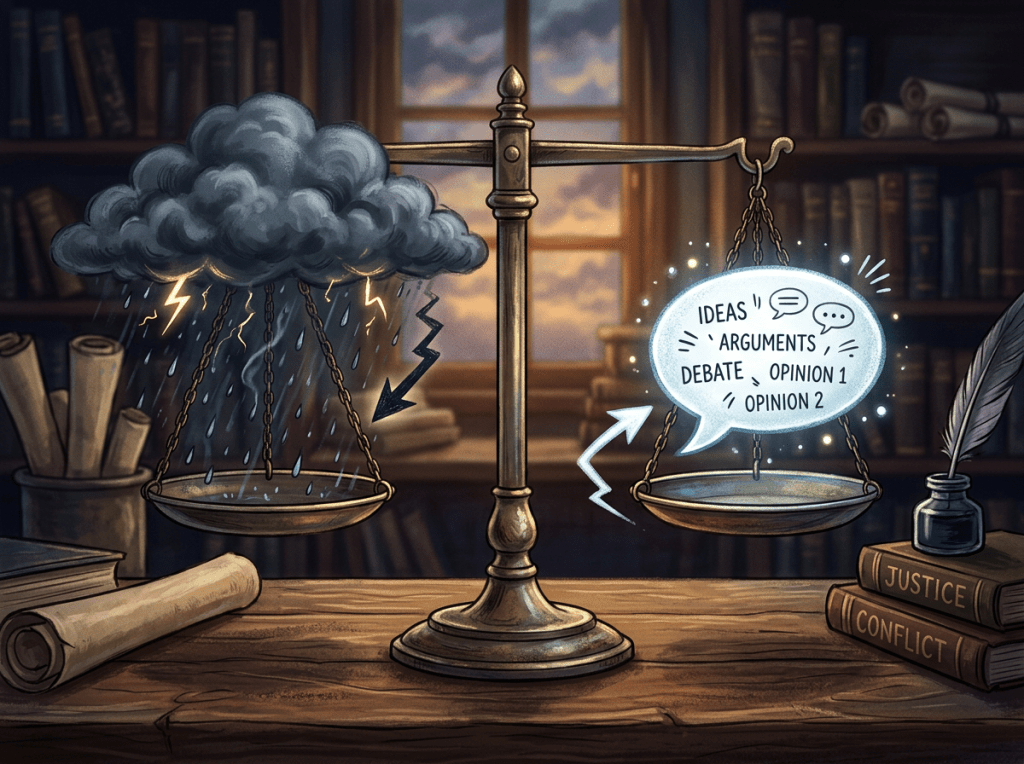
To tackle any issue one must first not delegitimise the position of those persons who caused the alleged problem. All issues are “people” issues, premises on a belief, a position taken by them.
Protest is the expression of a disagreement that can find no other method of expression. The people who express their disagreement through protest are not, by default, legitimated by it, but also cannot be assumed to be in error simply because they protest, the subject of their protest must be examined to determine its validity. It is only if they could express their perspective using more moderate means that their current protest could be labelled as unreasonable a priori. And if their protest is without malice toward person or property, maybe merely an inconvenience or a disturbance, then it is permissible under western rules and rights as described in law despite being a priori unreasonable. They feel something, so they must believe something so as to arrive at a passionate place, one that might cause them to act, emote, or at the least become verbal. People do not act without impetus.
We can’t start be delegitimising this for two major reasons, one that we do not wish to have the legitimacy of our own argument removed by the same means (will your acts to be universal and reversable – Kant), and two we have the right to hear nonsense so we can call it nonsense. There are no persons that exist who would nominate other persons to hear what they could hear for them, on their behalf, and then have those persons decide what can be allowed and what can be blocked. That’s not a real thing, we do not view ourselves as thinking adult creatures so intellectually insufficient as to merit sponsoring an external intellect to make up our minds for us. Information is only justifiably hidden when it poses a greater threat to the security of persons, not when it poses the threat that they might learn from it and maybe change their perspective. Though in the USA there are movements to curb the availability of certain books.
Why I say not to remove legitimacy is because those who are affected by the beliefs of others, especially if those others are influential, will not be dissuaded by the removal of the platform of, or the making unavailable by conventional media of, their chosen influencer. Quite the opposite will and does happen. The perceived plight, from their perspective the unjust treatment, of their influencer, becomes something stronger in their minds. the process of making heroes is that they must withstand that which is unfair, so it is a bad tactic to play into. When overt and obvious power uses its power to quell any form of protest, those that believe, or are at least intrigued, have their suspicions, however wild and implausible, fuelled by that intervention of power. You notice when something disappears, you notice parentalism, you notice your governance removing something even if you cannot remember what has been removed, and humans naturally rally against such things.
By directly engaging, taking on, publicly facing protest, by including it in the conversations of our time, we may find resolution, some truth, or even tease the ridiculous out to the satisfaction of those that will now have their falsehoods dispelled before others, and then be forced into thinking instead of just repeating. Each thesis must face its antithesis to find an acceptable synthesis, that’s Hegel, and he’s right. And every argument must face this scrutiny as a necessity to having any merit at all. If power forces adherence then this is an indicator that whatever postulate it scaffolds is in fact so shaky that it could not withstand the force of an argument, therefore it is invalidated by requiring power to stay upright, and power to marginalise dissent against it. This is why certain journalists do not get invited on breakfast shows, because they understand how to criticise falsehoods. I’m thinking about Peter Obourne, Owen Jones etc. Truths do not need power, they may need argument to convince people yes, but once demonstrated they become part of a fabric of human knowledge that is as basic to us as times tables or simple linguistics.
Imagine 2 people debating in front of an audience. Person one says “the world is flat”, person two says “I’m not going to sit here and listen to this crap” and leaves. Does this disprove anything about person one’s claim, will the audience be satisfied that the earth is not flat because person two would not engage and instead opted for a dramatic and emotional exit? Imagine instead that person two first asked “what evidence have you brought?” and then attacked the evidence that was presented, rendering it unuseful, following up then with their own evidence which offers more rational reasons to compel the audience? What would be the reasonable outcome of such a dialogue? I suspect that the reason why some people reach for the support of a power, I mean specifically those that align themselves with the wealthy or the church, realise early that they will need it. It is an oft seen tactic of charlatans, conmen, priests, and grifters in the political spectrum of debate to attempt a pre-building of the circumstances that will avoid any scrutiny of their position. A well supported YouTube news outlet describes this as “thumbing the scale”, and I can’t find a better way of describing it. The hope with nonsense is that it gets so battered back by argument that it never becomes anything other than fringe perspectives spouted by ignorant fools, unfortunately the American president has done what I have described, he has given voice to lunacy and prevented criticism, so now we hear people like RFK jr presenting the wildest and most foolish of theories, unproven and untested by experts, on an almost weekly bases.
In my country Maggie Thatcher de-platformed nationalists and their representatives, and for many years this tactic solved absolutely nothing. Molam, Clinton, Blair, Hume, Trimble and a few others brought a lasting peace (save for some hardliners and career criminals) to the disputed region through dialogue and negotiation. Once given voice, and guarantees in legislation that they would be treated with fairness before the law and endowed with equal rights to pursue their agenda in a political sense, an agenda that many did not agree with and still don’t, the nationalist minority quieted their support for, and distanced themselves from, those hardliners that they might once have described as “freedom fighters”. Thatcher would have described them as “terrorists”, and I will not argue that she was wrong in this piece, just that her approach was proven to be.
By legitimising the political aspects of nationalism, these peacemakers delegitimised the armed groups, without suppression of might, and all but removed this option as an option for the majority of reasonably minded people. Most people, regardless of political perspective, I hope, can be described as reasonably minded in the absence of other pressures. This is what works, we can know this because it did work, in fact it is the only thing that ever works other than complete annihilation. At the time I am writing this I believe that Trump will find this out sooner or later regarding Iran. Terrorists are only freedom fighters if they have no political capital, by giving the nationalist representatives a seat at the table, the negotiators forced them to actually represent the reasonable majority that holds the same agendas as most people do. Healthcare, education, justice, opportunity, and the right to progress without unjustifiable barriers. Sein Fein is a proper political party now that has to actually attend to bin collections, policing, healthcare, parking and potholes. This does not mean that they have distanced themselves from their support of an armed struggle, it just means that they cannot use the threat of it any longer.
On the other side of the coin there is the process, by motivated mainstream media, whereby a subject gains a legitimacy it maybe shouldn’t have. I’m going to criticise the support of zionism now because it is on trend and breathing down everyone’s neck. I give no more than a rat’s ass if that makes you think I am prejudiced, I am, but universally not just against this religiously founded subject. I do not believe that there is any natural legitimacy to a theological position written primarily by bronze aged ignoramuses, certainly not in a comparison with better social and political treatises, which we have from Kant, Mill, Locke, Rawls, Plato, Nozick, Dworkin, Marx etc. Followers of said ideologies, because that is what a theology is, a theory of how to live applicable to all persons as proscribed by the true believers, and often it is the underpinning motivation for violence and a clear conscience regarding it, are mistaken in my opinion and prevent progress.
When I say progress I mean as a species, scientifically, toward peace, as well as intellectually. Give me a few examples of where I’m wrong if you can. Firstly, like I just said, religion is ideology, not truth nor fact. If truth is that which is acceptable to all, like the importance of rights, and fact is what can be demonstrated repeatedly, like gravity. No no no, religion is a way of structuring one’s life based on a set of parameters that are more than arguable and not at all proven to have any necessity other than for the ego. Secondly, it is against our nature as thinking animals to accept that an ideology we ourselves do not believe in, or adhere to, should have the power or right to inhibit our speech or actions if we feel those words and deeds are perfectly acceptable in a free society. I, just like you, do not wish to be caged by someone else’s belief system. By all means please try to convince me otherwise…
So what is the legitimacy I speak of? What I mean is that some people who choose to live in some way can, and do, persecute some people who choose to live in another way, and us as viewers must accept that these paths have been chosen by them. Yet, we as a thinking species that has more than 25 centuries of philosophical reason under our hats, have created a set of parameters that should, ought to, are spoken of as if they do, override the narrow desires of adherents to any competing theology from a minority. And any single religion is of course a minority in a developed nation, this is why, in my opinion, Israel should not be seen as a developed nation. We have a set of rules that speak to the rights of persons that cannot be removed by them being labelled falsely by another set of people.
The mediation of persons as “enemy”, simply for existing as they do under the umbrella of a differing ideology, regardless of what they may personally express, is not a thing that we can or ever could justify. It is not permissible under our western values to incarcerate people for a perspective, just an action, perspective is better dealt with through reasoned argument like I have already stated. However, there is one state that is consistently allowed to describe, and persecute, another people, and specifically they do this because they have a theology that they claim mandates them to do so, and justifies their actions in a circular argument that is made acceptable by its goal once realised. You may know this strategy from the Pax Romana, or Persian, Mongol, British, or even Nazi empires of history, where every action taken in the pursuit of the goal will be made okay when the goal is ultimately realised. We speak of this sort of thinking in philosophical moral terms as Utilitarianism, in more common speaks we may say “the end justifies the means”. It is not the goal of this piece to present an argument to this moral theory, but I will say it has some serious ones that would make you question adopting such a position once understood.
The world watches on doing nothing. Worse though, we, the world that is not Jewish nor Zionist, even encourages the rhetorical justifications of, and sympathises with, the easily identified aggressor in this case. This cannot be in line with our developed rules, you know the ones where people have equal rights to exist, or that land cannot be annexed by force. Their apartheid is not something that we would allow here, not yet anyways. Britain prevents the persecution of Jews by any other group, and that action, protecting the rights of a minority, puts us in a natural opposition to any state that persecutes a minority, so Israel if we were consistent to our own ideology. This is what is so obviously wrong with the protests in favour of Israel, they are protests to further enable a wrong, not to support a right. None of the normal rules apply when it comes to the Zionist state, and if they wish to be this way the least we could do is to criticise it, or admit that we, I mean we the state as represented by a government not we the people, are supporting it.
We have tens of thousands of persons being persecuted, killed, allegedly raped men as well as women, and driven from their homes, and because they are having this inflicted on them by the Zionist state, we continue to remain silent as if it is reasonable that we uniformly support an ideology that we do not practice and a set of conditions we would not allow on our soil. Now if there was any example ever needed of media bias it is apparent here, no? I watched TV this morning following the stabbings of two Jewish persons by a violent man who I assumed, because of the way the information had been presented, had picked his targets because of religious prejudice. My surprise was not that this made the news it was that this was all the news and all the commentary and all the opinion pieces of the day, it dominated all the words of that day and many of the words of the days following.
A couple of weeks before that incident happened, a pro-Iranian protester had been stabbed by a pro-Israel protester on a London street, yet there was no, zero, mainstream media coverage of that attack. The other surprise is that the people waving Israeli flags in London and protesting that their peoples are not safe, asking that more than the law you and I get, be done for them, are also calling for the banning of marches in support of the people who are being so persecuted by the country they’re waving the flag of. The call is for some sort of prior restraint of perspective and protest, this goes directly against the ideals of British society regarding freedom to express dissatisfaction, yet we give it air time (as we should) and give no similar air time to those that wish to argue against it.
Imagine my further surprise when I learned that the attacker of the two Jewish victims had attacked a Muslim shortly before the second and third incidents, and imagine how I viewed the supposedly unbiased BBC coverage in the light of that new data? Information I would hasten to point out that they, the BBC, likely already knew and likely chose to omit because the narrative of the full story would not have been as juicy had it had to be presented as the act of a mentally ill person against some innocent people, two of which happened to be Jewish, and one not. What I am saying is the lens often matters as much as the object being viewed. Tennessee Brando, another YouTube voice, calls the acts of the media, the torture they inflict upon themselves to arrive at their weak arguments in support of clearly unstable positions if they were to be unbiasedly argued, as “sanewashing”. A term I think gets right to the point. The point being that media is attempting to normalise certain prejudices and exacerbate others in value terms.
I understand that a person motivated by hate, expressed themselves in violence, and that is no good thing. The thing I would say about that is that as soon as someone attempts to be violent with another person they have broken an existing law, and should be subjected to the weight of that law. What I cannot get my head around is the idea that a person who has not, and has no provable intention to inflict violence, could be inhibited before the fact from expressing an opinion or raising a differing flag as a symbol of their perspective. How can we declare a side, as a society, a side that we are on, when our laws and social structures have been modified to accept the idea that people have the right to protest and express their views without restraint under certain criteria? And are we to abandon those laws and norms, what would we choose to do otherwise, and what would that look like? I think we should be very careful, these conditions were hard fought for in the first place.
These two perspectives on what law is are in opposition, one says that laws step in to inhibit, the other says they protect. If I think Cheese and Onion, and you think Salt and Vinegar, then we each have the right to express our position no matter how wrong we are, the same needs to be true for political perspectives, we need to hear each other and come to some sort of acceptable synthesis. We may not change, but those listening might. If you and I think differently then I want to know what you think so I can argue against it if I think you are wrong, is that not my right, is it also not the right of others to view this? I offer you my perspective and invite you to argue by expressing my questions in this blog, so argue with me if you think I am in error (with reason not stupidity please, passion and convictions do not strengthen an argument, they merely attempt to do so). I believe what I think only until I am convinced otherwise by a better argument, and I will continue to think that’s a reasonable approach.
Let’s have a thought experiment… let us imagine that a footballer has committed a crime, and then let’s us imagine that we could get to a point where we supported some people in calling for a ban on football entirely because of the actions of one or just a few persons. Can’t get there can you? It is no different, this thought, than lumping everyone that hates the violence of Israel against the people of Palestine (I noticed google docs did not autocorrect and capitalise Palestine… details matter!!…) in with the persons who commit acts of violence against Jewish people living in British Cities. We are not the same, I am not a person of violence, I am no threat to the bodily person of any Jewish individual, nor do I support violence against anyone for their perspective. But I will argue endlessly that I have the right to strongly oppose what I feel is wrong using words, as I am doing now, and if that makes me an intellectual threat to their political ideology then that should always be okay. To ban me, and others, or marginalise the argument by marginalising the persons who make it, from criticising a theocratic state that pretends to be a victim while it carries out horrific acts that are neither necessary nor justifiable, is to prove that the ban itself indicates a failure of reason in a society that pretends to be reasonable.
In closing I’ll repeat myself, no argument needs any more power than it already contains, adding power erodes validity.


Leave a Reply