I fear social media just as you do, I see it as a force for possible good that will of course be used by the powerful to cement their power if they are able. And if it cannot be used by them they will act to curb it by creating a non-statistics based fear, a social truth, concerning it, one that allows for effective controls. Effective for them I mean. We currently see a movement growing to ban young people from social media, and we all understand that in a few cases we can say that social media has been harmful to a small amount of young individuals that have been influenced by it. But, and I am no expert I’m just a guy with an opinion, most young people use social media to know things, right or wrong, and in recent times it has been many times a force for good in that it allows these young people to also know that their passions are not isolated. To realise that others feel dissatisfaction as they do is important in a psychological sense, we feel less alone in our woes if we know others have the same woes also.
Social Media has brought forth movements. Young people tend to be hopeful, naturally left-leaning, caring, involved, environmentally minded etc. Some folks might call this “woke”, a derogatory term used in an attempt to postulate emotional engagement with external objects and persons/animals as ‘weakness’, in fact Elon Musk said as much when he stated that “Empathy is weakness”. Others may moot it as an unfeasible position, naivety, pie-in-the-sky optimism. It is a force nonetheless, affect not effect like the networks of wealth play on with their charity appearances on game shows and telethons, those are tactics.
How is social media and its distortions any different to the television or the radio or the newspaper or the classroom? People have always influenced people, the powerful have power because the masses allow it to be so, this tacit agreement must come from somewhere. If the masses wished it not to be so they would make it not so, nothing can stop the revolution other than itself. Though there are many mechanisms that protect power against hard revolution, there are few that protect against the soft kind, the alternative offer.
What the curbing of social media may do is to instil in the mind of the young person that there is no alternative. How it will do this is by reducing the ability of the youth to know things outside of the established norms they are presented with in classrooms and on their TVs, thus bolstering the hegemony of the current structure. I however have an argument, possibly a weak one, against this being effective, and it is premised on inner knowledge, what we might call innate nature, perpetual hope.
“Hope is like gravity, a weak force that, even in a vacuum where there are no atoms, continues to influence all objects“ – Me
Hope comes from an old source, many in fact, best expressed by science fiction writers maybe when it is pointed out to us as a facet of the human condition – that mankind under all circumstances will wish, at some base level, to be free from constraint or from the influence/power of others. Especially power that is against their own best interest and does not serve a greater good. In other words, unjustified unjustifiable power. This is why, whatever form of totalitarianism which arises, in whatever era, and supported by whatever base of power, simply cannot win in totality and perpetuity. That’s not to say that power and influence can be destroyed, while people are unequal structure will be unequal. It is what is acceptable as unequal that is the question, how much can and should we live with?
Hope provides the reason why all empires eventually fall, because the empire suits only the oppressors. Empires are small centres that exploit large peripheries, and as such are always outnumbered. People recognise that they are not the beneficiaries of their labours and they collectivise, overthrow their oppressors, softly or with violence; the pitchfork or the ballot paper. We now witness the rise of the left in Europe (I’m writing in 2026) with Viktor Orban defeated heavily in Hungary, Trump showing the lowest ratings of any US president ever, the establishment being challenged daily in the UK, and people starting to look at the yachts and not the dinghies as the source of their inequalities. This is hope expressed as a soft revolt, and it will win by the ballot if it does win. I cannot help but suspect that Social Media is somewhat the force behind this movement, because it sure isn’t the mainstream TV that is owned by those that wish the status quo or worse, and who create fear and support untruths though their broadcasting choices.
That’s something to think about at least, why the big furore about Social Media and why right now? Why is this important at this time and what purpose does it serve to be so prominent in an owned news space where the issues of the day are a scripted performance of news as entertainment rather than what is actually horrific and frequently occurring? I could give the example of the Israeli detention facilities that have been alleged to be the sites of frequent sexual assaults of their Muslim detainees, I could cite the US president openly threatening what is deemed by international justice as war crimes or a potential genocide, I could point to the war in Sudan which is claiming more lives than anything happening in the middle east yet is almost completely unreported here in the UK, I could find many stories online from credible journalism outlets that deserve the attention of the public much more than a few cases of influenced teenagers, so again I’ll ask, why the focus on this and why now? … My Partner Em had a lightbulb moment on this one recently, and I’m sure she is not alone in her suspicions.
Don’t get me wrong, I have deep sympathy for anyone that has lost a loved one to an influenced errant decision that that young person made to participate in something that was unwise or dangerous. What I am pointing out is that we have no way to statistically say that this is what Social Media does or sets out to do primarily. Yes it is motivated to manipulate, but maybe only in keeping the fish on the hook and the person absorbing capitalist ideas and ideals. Product is the likely most prominent motivation, adherence to the buying of stuff, and that may involve belief I’m sure. But Mark Zuckerberg wants you to spend and his backers, those that legislate, want you compliant, not to perish, because if you perish you cannot spend or support. So it could never be the ultimate goal of the platform to make persons endanger themselves, that is reserved for the nefarious persons present on it who derive perverse pleasure from harming people or having them harm themselves, and the platform just gives them an alternative to what Charlie Manson had where they had to be recruited in person. Why not seek those persons out and prosecute them? It must be easy for the algorithms to spot them?
I’m truly not being dismissive either, I am hopeful that young persons can by some other mechanism become more resilient than to be influenced, yet I do not believe banning interactions can achieve this, maybe the opposite might be true. I think school teachers and parents must in some way bear some responsibility to create in the young mind the facets of scrutiny and scepticism. Maybe I’m just personally lucky in that my dad was a guy who called “bullshit” on many things when I was young, and thankfully I noticed. It may be controversial, but I believe that truths are not dangerous to people, even young people, it’s just what we do with them is that is.
Falsehoods believed, ones that influence, are a danger of course, but no falsehood was ever quashed by banning the proliferation of it. The effective strategy is to argue against and convince otherwise. I’d certainly rather be armed with the mental mechanisms to face untruths than to have them kept from me in an act of government parentalism.
As a thought experiment, let’s say we took a North Korean, a devotee of his interregnum, and removed all potential punishment or consequences for non adherence to the dear leader, then could we very likely assume when free observations of alternatives were absorbed he would start to nurture an inner will to be unburdened by what currently restrains him? No prompt or offer would be necessary, he would wish better for himself and his family, maybe his people. It is only in the condition of not knowing that there are alternatives, that we stay in the cage of our social and political structures without participating in an upheaval. I would argue there will still be psychological turmoil because a person will always know that they are not free to pursue their own inner will even if they are not aware of what else their circumstance could be. It is not necessary to taste freedom to know that it is within your desires, it is enough to know that serving someone else’s prominence and happiness and watching them enjoy the riches of their life that you do not have is plenty to allow suspicion. Ancient Chinese people that served knew that they are servants, so did Caste system Indians, so did the subjects of kings and popes. They knew because there was a king or an emperor or a pope or a great leader, and it wasn’t them. Nietzsche captures the idea in one quote “If there are gods how can I bear not to be one?”
I admire Buddhists and people that do mindfulness, I also am somewhat envious of the serene facade presented by the truly pious, but I could never be these simply because it is a coping strategy in the face of injustice and inequality to turn off the anger and look to be happy in spite of something that one should have the courage to speak against. In this way Epicurus may have been wrong, the elimination of personal strife may not be the path to happiness if it is tainted with the feeling that one sat on one’s hands instead of protesting, if one failed to show the courage of one’s convictions. Yes it may be better for the individual to turn off the news or Social Media and avoid caring, but it is no good in the long run to be detached from the idea that there is something wrong that needs to be addressed. We need to collectivise our dissatisfaction so as to give it more strength than can be expressed by the words of just one person. To not do so is the path to further oppressions and inequalities, and it’s not a stretch of the imagination that the coverage is designed to make the viewer sick of absorbing it.
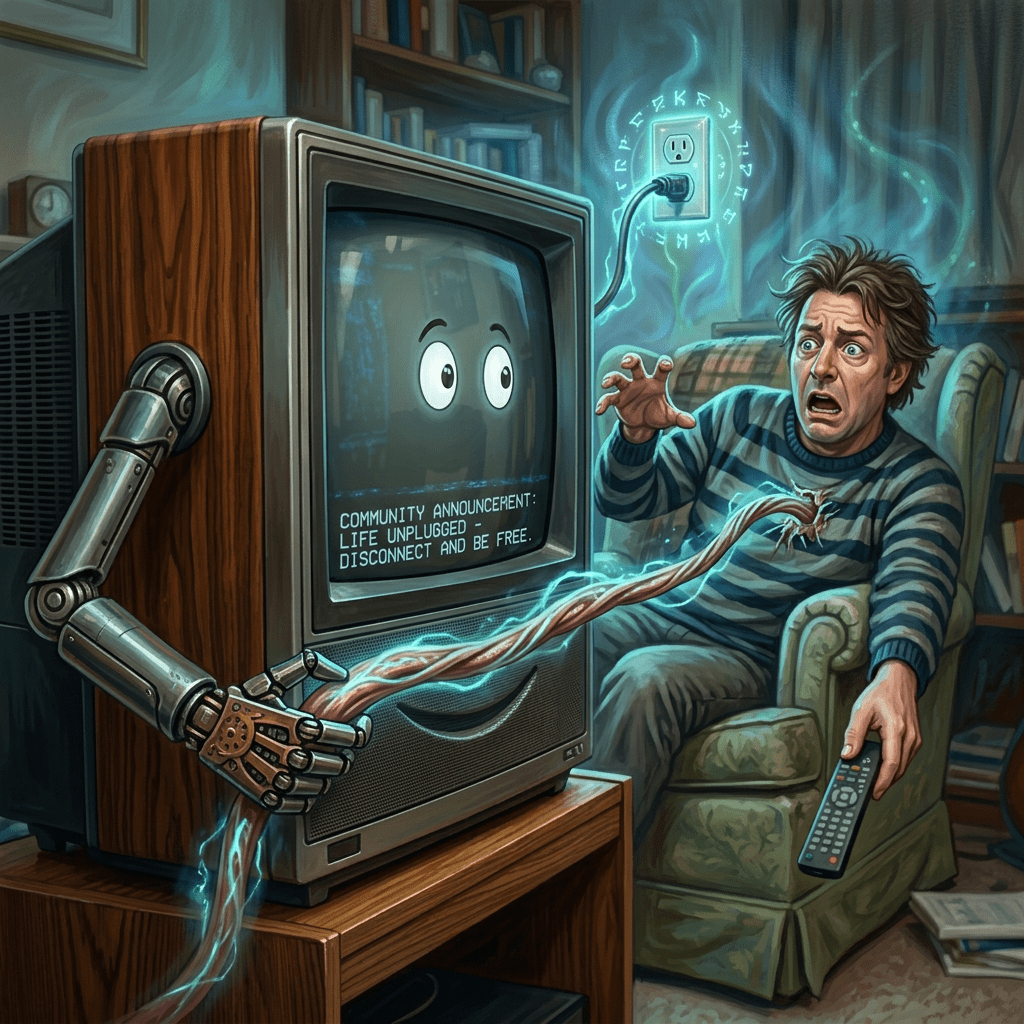
I can’t help but think of Rick Roderick’s warning about us not being able to turn the tv off, and of how maybe some day it would become so powerful that it could turn us off.


Leave a Reply